Write Confidently, Score Higher with AnswerWriting
Refine your UPSC/PCS Mains answers with clinical precision. Our AI-driven evaluation ensures clarity, relevance, and structured writing — helping you improve with every attempt.
Tip: Cite a recent SC judgement in the introduction to strengthen your opening.
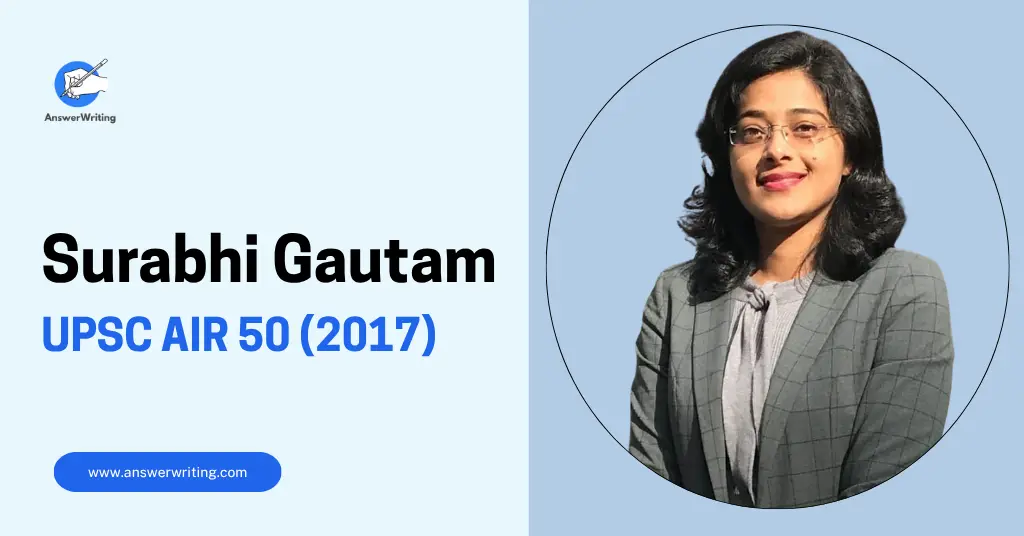
Surabhi Gautam: UPSC Rank 50, Strategy, and Journey | AnswerWriting
Surabhi Gautam: UPSC Rank 50, Strategy, and Journey
Can a girl from a Hindi-medium school in a small village, who was once mocked for her lack of English fluency, become an IAS officer in her very first attempt? Surabhi Gautam did exactly that.
Her story is not just about clearing an exam: it is about a relentless pursuit of excellence that saw her top almost every competitive exam in India before conquering the UPSC Civil Services.
Who Is Surabhi Gautam?
Surabhi Gautam is an IAS officer of the 2017 batch. Hailing from Amdara village in Satna, Madhya Pradesh, she became a symbol of merit over circumstances. She secured All India Rank 50 in the UPSC CSE 2016. Before this, she had already secured AIR 1 in the Indian Engineering Services (IES) 2013 and cleared exams for ISRO, BARC, and GATER.
Feature
Details
Full Name
Surabhi Gautam
UPSC Rank
AIR 50
Exam Year
2016
Service Allotted
Indian Administrative Service (IAS)
Education
B.Tech in Electronics and Communication
Optional Subject
Electrical Engineering
Cadre
Gujarat
Surabhi Gautam UPSC Marksheet and Score Details
Surabhi’s success was built on a rock-solid foundation in her optional subject and a balanced performance across all General Studies papers. Her technical background allowed her to score high marks in a subject many humanities students find daunting.
Paper
Marks Obtained
Essay
134
General Studies I
113
General Studies II
100
General Studies III
114
General Studies IV (Ethics)
102
Optional I (Electrical Engg.)
148
Optional II (Electrical Engg.)
151
Written Subtotal
862
Personality Test (Interview)
173
Final Total
1035
Educational Background and Early Life
Surabhi grew up in a village where basic amenities were often a luxury. She attended a Hindi-medium government school. Despite the limited resources, her academic brilliance was evident early on. In Class 12, she scored a perfect 100 in Mathematics and Science.
However, her journey was physically demanding. She suffered from Rheumatic Fever during her board exams, requiring her to travel 150 kilometers every fortnight for medical injections. She didn’t let the pain stop her and topped her state merit list. When she moved to the city for her engineering degree, she faced a new challenge: a language barrier. Her struggle with English led to ridicule from peers, which she turned into motivation to master the language.
How Many Attempts Did Surabhi Gautam Take?
Surabhi cleared the UPSC Civil Services Examination in her very first attempt in 2016. Her success was not a matter of luck but the result of a “topper’s mindset” developed over years.
By the time she sat for the UPSC, she was already a seasoned veteran of competitive exams. She had cleared the SSC CGL, worked as a scientist at BARC, and was the national topper in the IES exam. This “winning habit” meant she already understood how to manage vast syllabi and high-pressure exam environments.
While many engineers switch to subjects like Sociology or Anthropology, Surabhi stuck with Electrical Engineering. She believed in leveraging her strengths. Having topped the IES with the same subject, she had a deep conceptual grasp that few could match.
Her strategy was to treat the technical subject with the precision of a scientist. She focused on:
Solving previous 20 years’ question papers.
Ensuring zero errors in numerical problems.
Using clean, labeled circuit diagrams.
Key Resources: Standard textbooks like B.L. Theraja and IES Master notes.
UPSC Preparation Strategy of Surabhi Gautam
Surabhi’s strategy was centered on extreme consistency. She famously followed a “10 words a day” rule to improve her English vocabulary until she was comfortable writing her Mains in the language.
She followed a self-study model, focusing on creating her own notes. Her schedule was rigid: she balanced her job at the railways (after IES) with 6 to 7 hours of daily study. She emphasized that the quality of hours matters more than the quantity. For current affairs, she relied on a single newspaper and supplemented it with monthly compilations.
Books and Resources Recommended by Surabhi Gautam
Subject
Resource
Note
Polity
M. Laxmikanth
The “Bible” for Polity.
Modern History
Spectrum
Essential for Prelims facts.
Economy
Ramesh Singh
Supplemented with Economic Survey.
Geography
NCERT Class 11 & 12
Focus on maps and physical features.
Current Affairs
The Hindu
Read daily without fail.
Mains Answer Writing Approach
Surabhi’s mantra for Mains was “Sit, Write, Check, Repeat.” She believed that knowledge is useless if it cannot be expressed within 7 minutes on paper. She focused on making her answers scannable by using subheadings and bullet points.
A critical part of her success was the “Check” phase: getting feedback on her writing. Today, aspirants can replicate this discipline using the Answer Evaluator on AnswerWriting.com. It provides the same kind of detailed, parameter-based feedback that Surabhi sought through peer reviews, helping you refine your language and structure. For those struggling to start, Daily Answer Writing prompts are an excellent way to build the “first attempt” momentum she possessed.
Interview (Personality Test) Experience
During her interview, the board questioned her extensively on her transition from a village to a scientist at BARC and finally to the civil services. She was honest about her Hindi-medium background and her journey of self-improvement.
Her confidence came from her technical expertise. Even when faced with situational questions about administration, she maintained a balanced, practical viewpoint. She advises aspirants to be “authentic” rather than trying to project a fake persona of a perfect officer.
Service and Cadre Allotted to Surabhi Gautam
Surabhi was allotted the Indian Administrative Service (IAS) and was assigned the Gujarat Cadre. Since her induction, she has served in various capacities, including Assistant Collector and District Development Officer. As of 2026, she continues to be recognized for her work in urban governance and municipal administration in Gujarat.
Key Lessons Every UPSC Aspirant Can Take from Surabhi Gautam
Language Is Just a Tool: Do not let a lack of English fluency lower your confidence. It is a skill that can be acquired through daily effort.
Leverage Your Background: If you are good at your graduation subject, do not be afraid to take it as an optional.
The “First Attempt” Mindset: Treat every attempt as your last. This intensity is what separates toppers from others.
Consistency over Intensity: Small daily wins, like learning 10 words or writing one answer, compound into a massive success.
FAQs About Surabhi Gautam
What was Surabhi Gautam’s medium of exam?
She wrote the UPSC exam in English, despite coming from a Hindi-medium school background.
Which optional subject did Surabhi Gautam choose?
She chose Electrical Engineering as her optional subject.
Did Surabhi Gautam take coaching?
She primarily relied on self-study and notes she prepared during her IES preparation, though she took mock interviews and test series.
What was Surabhi Gautam’s rank in IES?
She secured All India Rank 1 in the Indian Engineering Services (IES) 2013.
In which attempt did she clear UPSC?
Surabhi Gautam cleared the UPSC Civil Services Examination in her first attempt.
What is Surabhi Gautam’s current posting?
As per available reports in 2026, she serves in the Gujarat Cadre, having worked in roles like Regional Commissioner of Municipalities.