Write Confidently, Score Higher with AnswerWriting
Refine your UPSC/PCS Mains answers with clinical precision. Our AI-driven evaluation ensures clarity, relevance, and structured writing — helping you improve with every attempt.
Tip: Cite a recent SC judgement in the introduction to strengthen your opening.
D. Roopa Moudgil: UPSC Rank 43, Strategy, and Career Journey | AnswerWriting
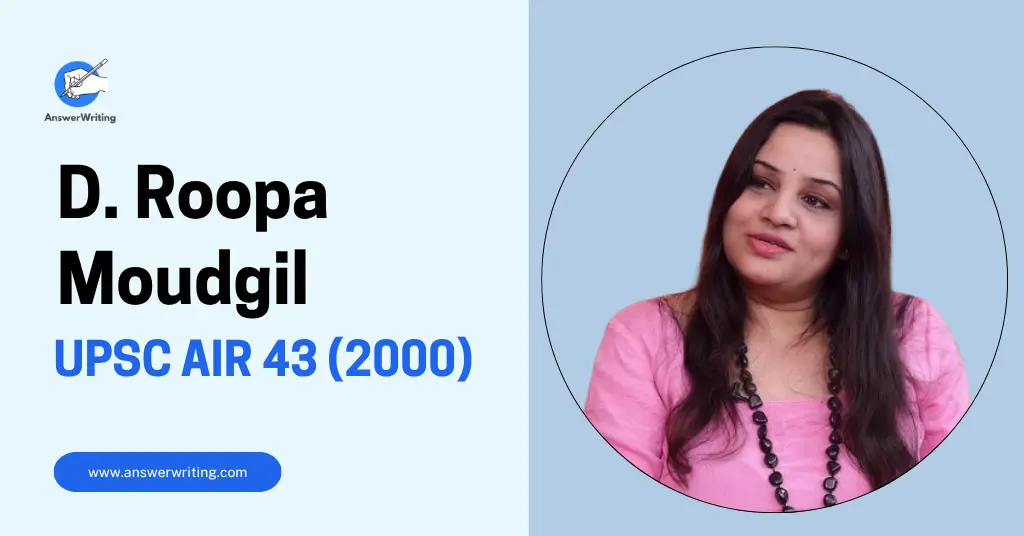
D. Roopa Moudgil: UPSC Rank 43, Strategy, and Career Journey
While most UPSC toppers aiming for a top-50 rank have their sights set firmly on the Indian Administrative Service (IAS), D. Roopa Moudgil was different. In 2000, she secured All India Rank 43, a position that guaranteed her a spot in the IAS. However, she chose the “Khaki” over the “Cane,” opting for the Indian Police Service (IPS) as her first preference.
Today, she is one of India’s most recognized police officers, known for her uncompromising integrity and fearless administrative style.
Who Is Roopa Moudgil?
D. Roopa Moudgil is a 2000-batch IPS officer of the Karnataka cadre. She holds the distinction of being the first woman IPS officer from Karnataka. Her career has been defined by her commitment to the rule of law, often leading to high-profile confrontations with political and bureaucratic heavyweights.
Feature
Details
Full Name
Roopa Divakar Moudgil
UPSC Rank
AIR 43
Exam Year
2000
Service
Indian Police Service (IPS)
Cadre
Karnataka
Optional Subject
Psychology
Education
M.A. in Psychology (Gold Medalist)
Roopa Moudgil UPSC Marksheet and Score Details
In the year 2000, the UPSC pattern required candidates to master two optional subjects for the Mains. Roopa’s high rank was a result of her stellar performance in Psychology and her ability to articulate complex social issues in General Studies.
Component
Performance Level
General Studies
High
Optional 1 (Psychology)
Exceptional (Subject Topper level)
Optional 2
High
Interview (Personality Test)
Outstanding
Final Result
All India Rank 43
Educational Background and Early Life
Roopa was born in Davangere, Karnataka. She was a brilliant student from the start, consistently excelling in academics and extracurriculars. She completed her graduation from Kuvempu University with a gold medal and later earned an M.A. in Psychology from Bangalore University.
Her childhood was heavily influenced by the National Cadet Corps (NCC). As a cadet, she developed a deep respect for the uniform and discipline. This early exposure to a paramilitary environment was the catalyst for her choosing the IPS over the IAS later in life. Beyond academics, she is a trained Bharatanatyam dancer and a classical singer, showcasing a rare balance of grit and grace.
How Many Attempts Did Roopa Moudgil Take?
Roopa Moudgil cleared the UPSC Civil Services Examination in her first attempt. Her success was not a product of years of trial and error, but rather a result of hyper-focused preparation during her post-graduation years.
She often attributes her success to a “clear-headed” approach. She didn’t view the UPSC as a gargantuan monster, but as a test of one’s fundamental understanding of the world. By clearing the exam at a young age, she ensured a long career in the service, which has allowed her to helm numerous departments across Karnataka.
Roopa Moudgil Optional Subject: Psychology
Having been a gold medalist in Psychology, Roopa had a natural advantage. However, she warns aspirants that “academic” psychology and “UPSC” psychology are different. The exam requires an application-oriented approach.
Her strategy included:
Theories of Personality: Deep diving into Freud, Maslow, and Rogers to explain human behavior in administrative contexts.
Social Psychology: Understanding group dynamics, which is crucial for the Ethics paper (GS 4) today.
Clinical Knowledge: Using her post-graduate depth to write nuanced answers on mental health and stress management.
For modern aspirants, finding the right “case studies” for Psychology or Ethics can be difficult. Tools like the Case Studies Finder for Optional on AnswerWriting.com help candidates map real-world scenarios to their syllabus, much like Roopa used her real-world observations to enrich her answers.
UPSC Preparation Strategy of Roopa Moudgil
Roopa’s strategy was built on the pillars of discipline and diverse reading. She did not confine herself to “UPSC-only” books.
Broad Reading: She read extensively on social issues, philosophy, and current affairs. This gave her a unique voice in her Mains answers.
NCC Discipline: She treated her study hours like a military drill. 8 to 10 hours of focused study were non-negotiable.
Note Making: She believed in handwritten notes. Summarizing a 20-page chapter into 2 pages of bullet points was her key to multiple revisions.
When starting out, many aspirants feel lost in the vastness of the syllabus. Seeking guidance from an AI Mentor can help create a personalized roadmap, similar to how senior mentors guided Roopa in her early days.
Books and Resources Recommended by Roopa Moudgil
Roopa relied on classic texts that build conceptual clarity rather than just providing shortcuts.
Subject
Book/Resource
Author/Source
Psychology (Paper 1)
Psychology
Robert A. Baron
Psychology (Paper 2)
Applied Psychology
Smarak Swain / Various
Polity
Indian Polity
M. Laxmikanth
Modern History
India’s Struggle for Independence
Bipan Chandra
General Studies
The Hindu Editorial
Daily Newspaper
Culture
CCRT Website & NCERTs
Government Source
Mains Answer Writing Approach
Roopa’s answers were characterized by clarity and a psychological edge. She didn’t just state facts; she explained the why behind social phenomena.
The Analytical Hook: Every answer started with a strong, analytical opening that showed her command over the topic.
Structuring: She used headings and sub-headings to make her paper easy to scan.
Balanced Perspective: As a future police officer, she practiced looking at issues from a law-and-order perspective as well as a social welfare perspective.
Today, getting instant feedback on such structural nuances is possible through the Answer Evaluator on AnswerWriting.com. It evaluates handwritten answers on parameters like structure and content, providing the same critical feedback that toppers used to get through rigorous peer reviews.
Interview (Personality Test) Experience
Roopa’s interview is the stuff of legends. When asked why a Rank 43 holder wanted to join the IPS, she spoke passionately about her NCC days and her desire to work on the ground to provide justice. Her confidence, backed by her achievements in dance and music, made a lasting impression on the board.
The board tested her on her psychological depth and her views on women’s role in the police force. She argued that the police force needs empathy just as much as it needs strength, a philosophy she has carried throughout her career.
Service and Cadre Allotted to Roopa Moudgil
Roopa was allotted the Indian Police Service (IPS) in her home cadre of Karnataka. Her career has been a whirlwind of high-stakes assignments:
Dharwad SP: Where she famously arrested a sitting Chief Minister in a long-standing rioting case.
DIG Prisons: Where she exposed the VIP treatment given to high-profile prisoners.
Home Guards & Civil Defence: Where she brought about significant administrative reforms.
Despite being transferred over 40 times in 20 years, she remains steadfast in her duties. Her career is often cited in Ethics classes as an example of “Fortitude” and “Duty over Self.”
Key Lessons Every UPSC Aspirant Can Take from Roopa Moudgil
Follow Your Passion: If you want to be in the IPS, don’t settle for the IAS just because “society says so.” Your passion will sustain you through the tough days of service.
Integrity is Non-Negotiable: Preparation for the exam is also a preparation for life. Build a strong ethical foundation now.
Multifaceted Growth: Don’t stop living while preparing. Her hobbies in music and dance didn’t hinder her; they made her a more well-rounded candidate for the interview.
First Attempt is Possible: With clarity of thought and a focused choice of optional subjects, the first attempt can lead to a top rank.
FAQs About Roopa Moudgil
Why did Roopa Moudgil choose IPS over IAS despite Rank 43?
She had a childhood passion for the uniform, sparked by her time in the NCC, and believed she could make a more direct impact on justice through the police force.
How many transfers has D. Roopa had?
She has had over 40 transfers in her career, often attributed to her uncompromising stance against corruption and administrative irregularities.
What was her optional subject in UPSC?
Her primary optional subject was Psychology, in which she was also a gold medalist during her academic career.
Is Roopa Moudgil the first woman IPS officer of Karnataka?
Yes, she holds the distinction of being the first woman to be appointed as an IPS officer in the Karnataka cadre.
How many attempts did she take to clear the UPSC?
She cleared the UPSC Civil Services Examination in her very first attempt in the year 2000.
What is Roopa Moudgil’s current posting?
Her postings change frequently due to the nature of her service. Aspirants should check current government gazettes for her most recent designation, though she has recently served in senior roles in the Home Department and MD positions.